Photographing Groups: Techniques and Perfect Poses
Master group photos with our posing, staging, and lighting tips. Pro tips for successful group portraits.
Introduction
Group photography is a distinct art form that requires specific skills to capture the essence of a community. Whether for a family photo, a corporate team, or a special event, a successful group photo requires more than just a simple click. In this article, we will explore the essential techniques, effective poses, and staging secrets to transform your group photos into true works of art.
The technical basics of group photography
Choosing the right equipment
For a successful group photo, the equipment plays a crucial role. A wide-angle lens can be useful for capturing large groups, but watch out for distortion at the edges. Instead, opt for a standard lens (50mm) or a telephoto lens (85-135mm) to avoid distortions and get a pleasing image compression.
Depth of field is also important. A moderate aperture (f/5.6 to f/8) keeps all subjects in focus while creating a nice background blur. For large groups, a smaller aperture (f/11 or f/16) may be necessary to ensure the sharpness of all faces.
Light management
Natural light is ideal for group photography. Position the group facing the light to avoid unflattering shadows. Outdoors, the soft light of the golden hour provides flattering lighting. Indoors, place the group near a large window to get natural, soft light.
If you use a flash, prefer a fill-in mode to illuminate the shadows without overpowering the natural light. For large groups, multiple flashes may be needed to balance the lighting.
Posing for successful group portraits
The importance of visual hierarchy
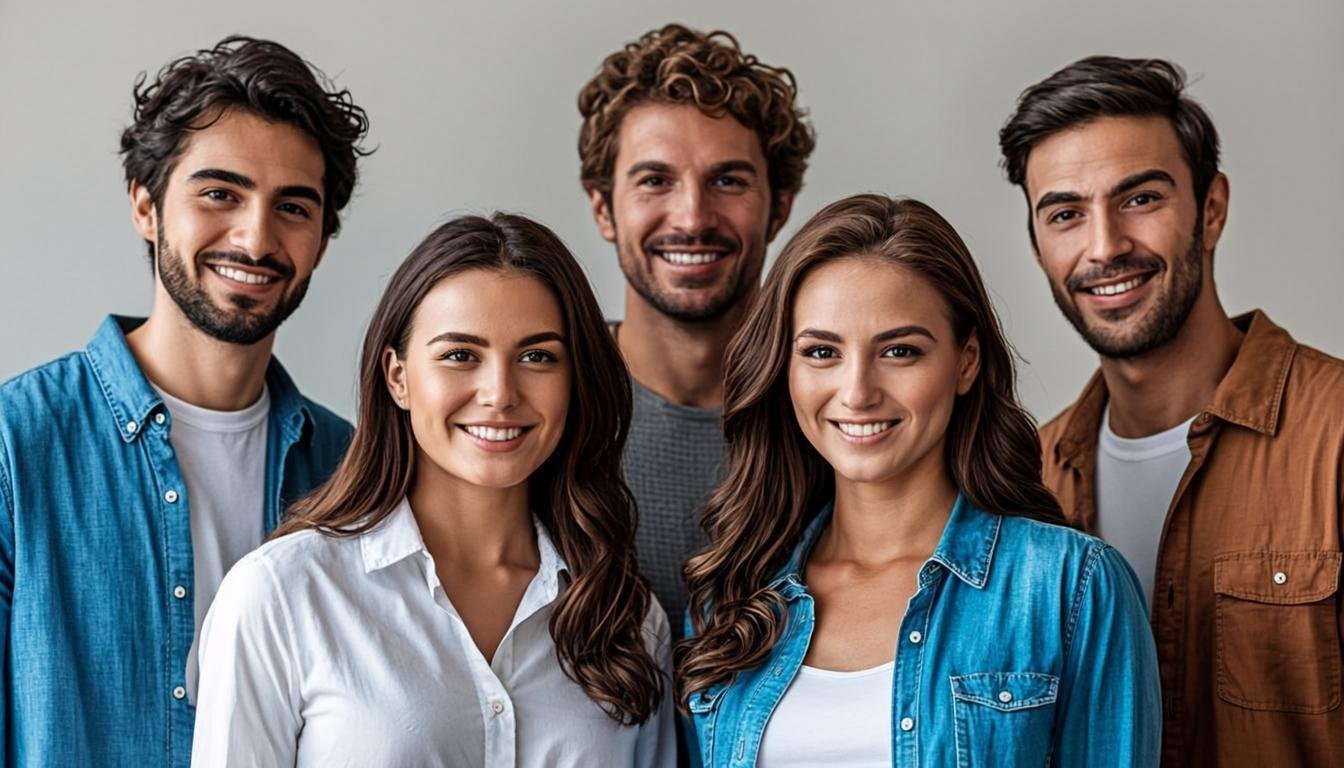
In a group photo, it is essential to establish a clear visual hierarchy. Place the most important people in the center or slightly forward. For family groups, position children and elderly people in the foreground, with adults behind them. People of the same height should be placed on the same line to avoid a disjointed effect.
Natural and dynamic poses
Avoid rigid and static poses. Encourage natural interactions between group members: a hand on the shoulder, a spontaneous laugh, a knowing look. For groups of 3 to 5 people, use the triangle technique to create visual balance.
For larger groups, think about creating sub-groups. Members can form small groups of 2-3 people with spaces between them. This avoids the "murmur" effect and adds more dynamism to the composition.
Classic poses and their variations
The traditional lineup pose (standing with hands on shoulders) has its place, but vary your approach. Try seated poses for family groups, asymmetrical poses for more dynamism, or interactive poses where members touch or look at each other.
For groups of friends or teams, let personality shine through. Relaxed poses, varied facial expressions, and spontaneous interactions will make the photo more authentic and memorable.
Staging and Composition
Choosing the Context
The background should showcase the group without being distracting. For a family photograph, a meaningful location works well: the home, a frequented park, a vacation spot. For a corporate team, a professional but not overly formal environment is ideal.
Ensure the background is simple enough for the group to stand out clearly. If the background is too busy, use a wide aperture to create a background blur (bokeh) that will draw the eye to the subjects.
Lines and Geometric Shapes
Use natural or created lines to guide the viewer's eye. A line of a bench, a pathway, or even the arrangement of people can form lines that lead to the faces. Geometric shapes like the triangle, circle, or square can also structure the composition harmoniously.
Balance and Asymmetry
Good visual balance is crucial for a successful group photo. This doesn't necessarily mean perfect symmetry. A well-thought-out asymmetrical composition can be more dynamic and interesting. Think about distributing the visual weight of elements to create a natural balance.
Specific Challenges of Group Photography
Managing Large Assemblies
For groups of more than 10 people, logistics become complex. Plan a precise layout, use a tripod to stabilize the camera, and consider using a remote trigger or self-timer to be in the shot. For even larger groups (20+ people), a ladder or a high vantage point may be necessary.
Coordinating Outfits
In a family or group photograph, outfit harmony greatly improves the result. Suggest a consistent color palette without requiring identical outfits. Avoid overly bold patterns or distracting logos. For formal events, guide the choices without being too directive.
Managing Children and Animals
Children and animals add a spontaneous but unpredictable dimension. Allow more time for the session, be patient, and encourage natural interactions. The most authentic moments often come from unposed moments. For babies, schedule the session around their sleep schedule to maximize cooperation.
Post-processing and Retouching for Group Portraits
Color Tone Harmonization
Post-processing is essential to unify the appearance of group members. Ensure that skin tones are consistent and that the lighting is uniform across all faces. For photos taken at different times or with different light sources, color tone harmonization is particularly important.
Correcting Common Problems
Common issues in group photography include closed eyes, unflattering expressions, or unwanted elements in the background. Use retouching techniques to correct these flaws. For closed eyes, you can sometimes open one by using another photo of the same subject.
Using Smart Tools
Artificial intelligence tools are revolutionizing the post-processing of group photos. Platforms like AllCombiner allow you to combine the best expressions from multiple photos to create a perfect image. These smart tools analyze each face and automatically select the most successful expressions, thus saving hours of manual work.
Conclusion
Mastering group photography requires both technical skill, creativity, and patience. By applying these tips for posing, staging, and light management, you will be able to create memorable group portraits that capture the essence of your subject.
To further optimize your group photos, explore advanced post-processing tools like those offered by AllCombiner. Their smart solutions can transform your shots into true masterpieces. Also discover our Pricing to access professional features that will elevate your group photography to the next level.
Related articles